
Abdominoplasty
Breast augmentation
Breast reduction & uplift
Laser resurfacing
Fat Grafting
Liposuction
Melanoma
Sun protection
Basal cell cancer
Squamous cell skin cancers
Skin grafts
Facial repairs
Tissue expansion
Facial fractures
Trauma & burns


  Basal and Squamous Cell Skin Cancers, and Melanomas  


Basal and squamous cell cancers are tumours of keratinocytes (unpigmented cells of the skin fabric). Basal cell carcinomas (BCC's) are by definition considered not to have the capacity to detach and spread to other sites. Nonetheless basal cell cancers can be dangerous as they can invade important structures (eg. eyelid, tear duct, nasal skeleton, ear, nerves) by direct extension

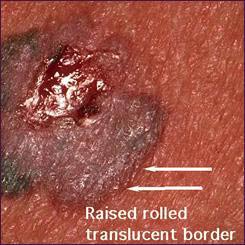
Basal Cell Carcinomas (BCCs) may demonstrate features including

  • raised rolled edge
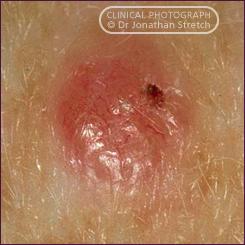
  • waxy nodular component
  • ulcerated component
  • fine blood capillaries on tumour surface
 
   
Basal cell cancer (BCC) with some pigmentation along left edge Classical example of Basal cell cancer: Note fine blood capillaries on tumour surface (telangiectasiae)
   
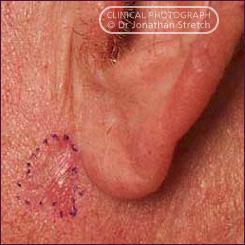
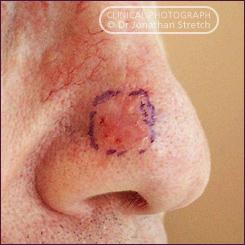
A more subtle BCC. The tumour edge has been dotted with a blue skin marking pen. A less common example of BCC with pigmentation around its edge
   
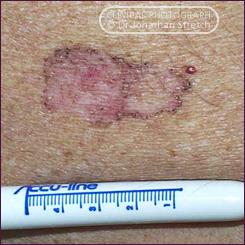
Another subtle BCC. The tumour edge has been dotted with a blue skin marking pen.
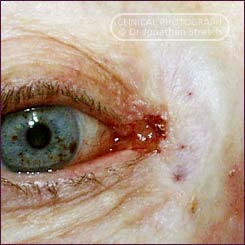
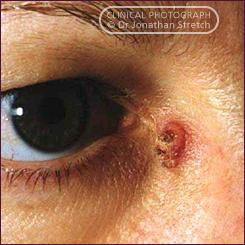
BCC involving the junction of the upper and lower eyelids (canthus). Untreated, this tumour can invade important structures.
   

Squamous Cell Skin Cancers (SCC)

Squamous cell carcinomas (SCC's) which the result of longstanding sun exposure and have not been ignored for extended periods are relatively unlikely to metastasise (spread to distant sites).However, they can have this potential.

SCCs can at times closely resemble BCC. It can be difficult to make a definitive diagnosis with these skin tumours before microscopic examination by the pathologist.

Some SCCs are characterised by greater bulk than BCCs.


Smoking and Squamous Cell Skin Cancers

Recent research indicates that smokers face a three-fold increased risk of developing SCC of the skin. A study of nearly 600 patients in the Netherlands linked smoking to squamous cell cancer - but not to melanoma and basal cell carcinoma. Smoking has now been associated with an increasing number of cancers beyond lung cancer. These include bladder, head and neck, cervical, and skin cancer.

Reference:

Relation Between Smoking and Skin Cancer
S.A Hertog et al
Journal of Clinical Oncology, Vol 19, Issue 1 (January), 2001: 231-238

 
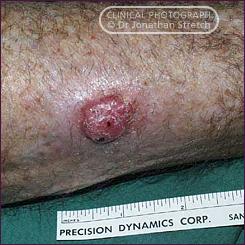
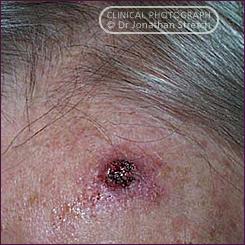
SCC on the lower leg. SCC on the forehead. The relatively rapid division of tumour cells and abnormal adhesion between these cells has resulted in the tumour ulcerating.
   

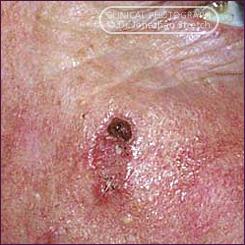
When this tumour was removed it was described by the pathologist as a squamous cell cancer(SCC). It is relatively symetical and has a central keratin plug.

Keratoacanthomas can have this appearance and are very interesting because many (but not all) of these will spontaneously disappear over several months. Careful assessment is needed to manage these safely.

Squamous cell cancer on the cheek. This tumour might be assessed as a basal cell cancer until examined by the pathologist under a microscope. Distinction between the two tumour types may not always result in any practical differences in their treatment


More about skin cancers

Basal Cell Cancers

Squamous Cell Cancers

Skin types and risk factors for skin cancer


Jonathan Stretch Plastic Surgeon D.Phil (Oxon) F.R.A.C.S.